|
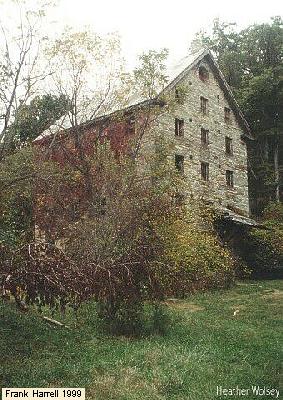
A side project Frank got into while working on the Web pages at Manassas was the historic Bevelery Mill. Located in the Thoroughfare Gap about 15 miles west of the Manassas Battlefields. Most of this text is from the Manassas web site section for Beverly Mill. Thoroughfare Gap Thoroughfare Gap is a narrow gap between Bull Run and Pond Mountains, through which Broad Run flows as it descends 87 feet. The Gap was used by migrating buffalo and traveling Indians long before it became a transportation corridor for grain and goods between the Valley and the Atlantic. Mention of the Gap was first recorded in 1697, by a group of Marylanders passing through in search of a band of Piscataway Indians. Later Tidewater planters used the Gap as a route to the rich Shenandoah Valley. During wartime its use became even more strategic: it was an escape route during the French and Indian War, during the Revolutionary War it was the route east to join the army, and during the Civil War, it was a strategic passageway for both armies. At the time of the Spanish-American War in 1898, 10,000 American troops were stationed at the Gap to avoid a typhoid epidemic in Alexandria. For many years, the Gap has been a major east-west thoroughfare. Today, Interstate 66 takes thousands of people east and west in their travels, many commuting to the Washington, DC area to work. These travelers are able to see the charred walls of the mill. Hopefully, in the future they will be able to stop, safely explore the stabilized ruins and learn more about the mill and the surrounding area. |
|
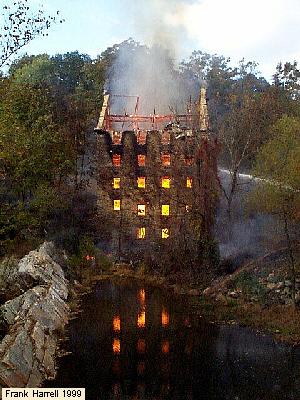
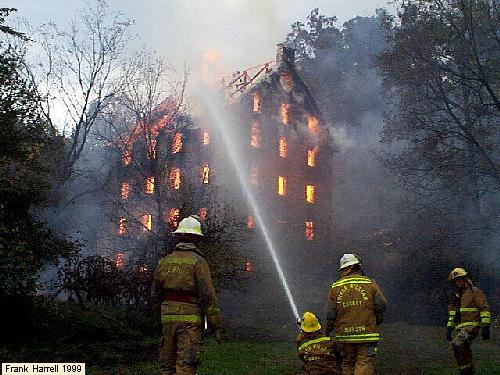
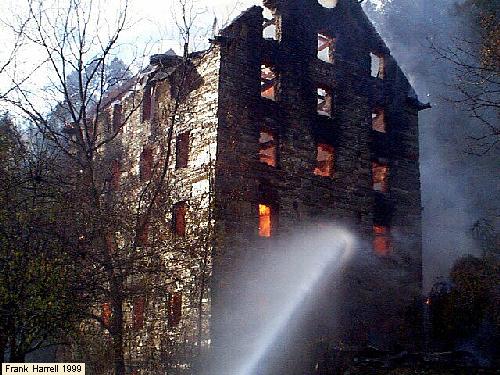
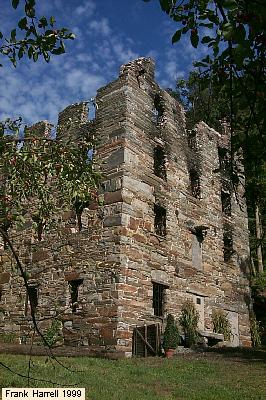
On October 22, l998, Beverley Mill was tragically vandalized and gutted by fire. Beverley Mill was built in 1742 by Jonathan and Nathaniel Chapman, brothers from an enterprising, well-connected colonial family. Enlarged in 1758, the mill became a prosperous gristmill that fostered the development of the Shenandoah Valley as a wheat and corn producing region for the next one hundred years. Due to the mill's location between the Valley and the city of Alexandria, corn and wheat could be transported efficiently by wagon to the mill, ground into cornmeal and wheat, and then shipped from Alexandria to ever-expanding markets in Europe and South America. In 1759 Fauquier County was created from old Prince William County, and the related documents noted that the boundary between the two counties passed through the mill, as it does today. The prosperity of the mill was enhanced when, in 1852, the Manassas Gap Railroad was completed, passing beside the mill and reducing the travel time to Alexandria. In 1858 the Chapman family enlarged the mill, raising it to a total of seven stories and making it a model of agricultural technology. Beverley Mill has ground cornmeal and flour for American troops during seven wars: The French and Indian, the Revolutionary, the War of 1812, the Civil War, the Spanish-American War, and World War I and World War II. |
|
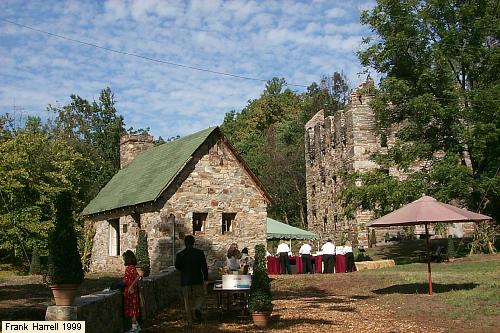
| Soon after the fire, the Turn The Mill Around Campaign, a 501(c)(3) tax exempt operating foundation, obtained ownership of the property and has begun the steps necessary to stabilize the walls of the mill. The goals of this non-profit organization are to preserve the structure of the mill, to provide public access, to develop an interpretive program of the history and significance of the mill and Thoroughfare Gap, and to raise the funds needed to carry out these goals. Plans call for pedestrian pathways around the mill and along the head race providing views of the millpond, flume, sluice gate, forebay, 29 foot wheel and tail race. In addition, visitors will be able to enter the mill to gain a greater appreciation of the enormity of the mill and the beauty of the stone work. Interpretive signs will explain the milling process and the impact of the industrial site on the evolving economy of the area. The old stone mill store will be restored and used as a kiosk interpreting the history of Thoroughfare Gap. |
| Many fire fighters battled the blaze. |
|
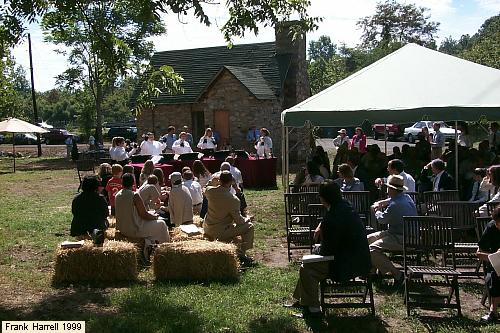
| On October 3rd, the Turn The Mill Around Campaign held a party to raise funding. |
| The decision was made not to rebuild the mill, but it must be stabilized to prevent the winter from destroying what was left. |
| Many important people came including senators, congressmen, and the head of Virginia's highway department. |
|
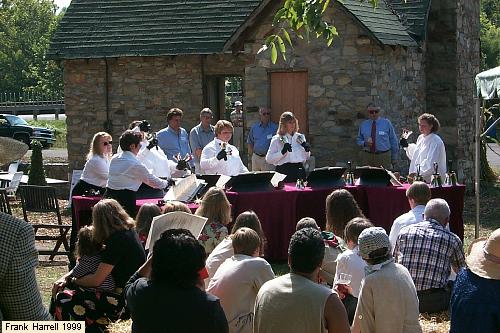
| A hand bell choire was on hand and there music was beautiful but difficult to hear because Interstate 66 is right next to the mill. |